
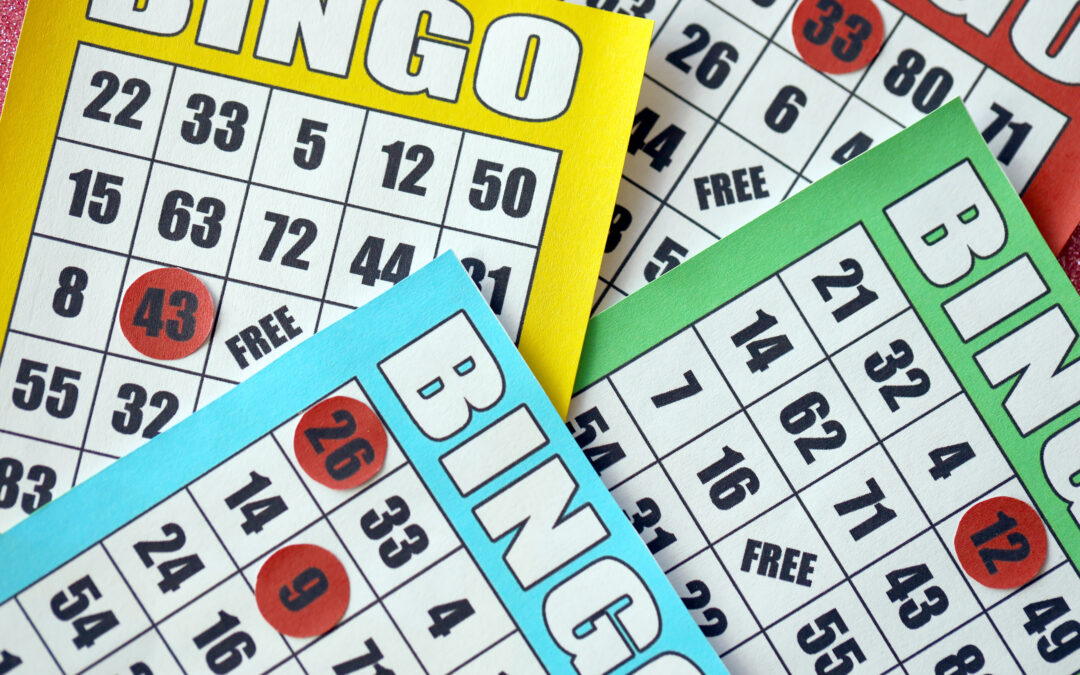
You’re familiar with that sensation—your ink dauber is positioned over the card, your heart gives a small jump, and your eyes focus on the last empty square. The person calls your letter and number. You leap out of your chair, take a deep breath, and shout across the room as loudly as you can: “BINGO!”
Few activities match the pure, nostalgic thrill of this timeless classic. Bingo bridges generations like almost nothing else. But do you know Bingo’s history and where it got its name? It turns out there lies a quirky, surprising history filled with eccentric inventors, mathematicians, and unexpected origins. Check out these 7 odd facts about America’s favorite game.
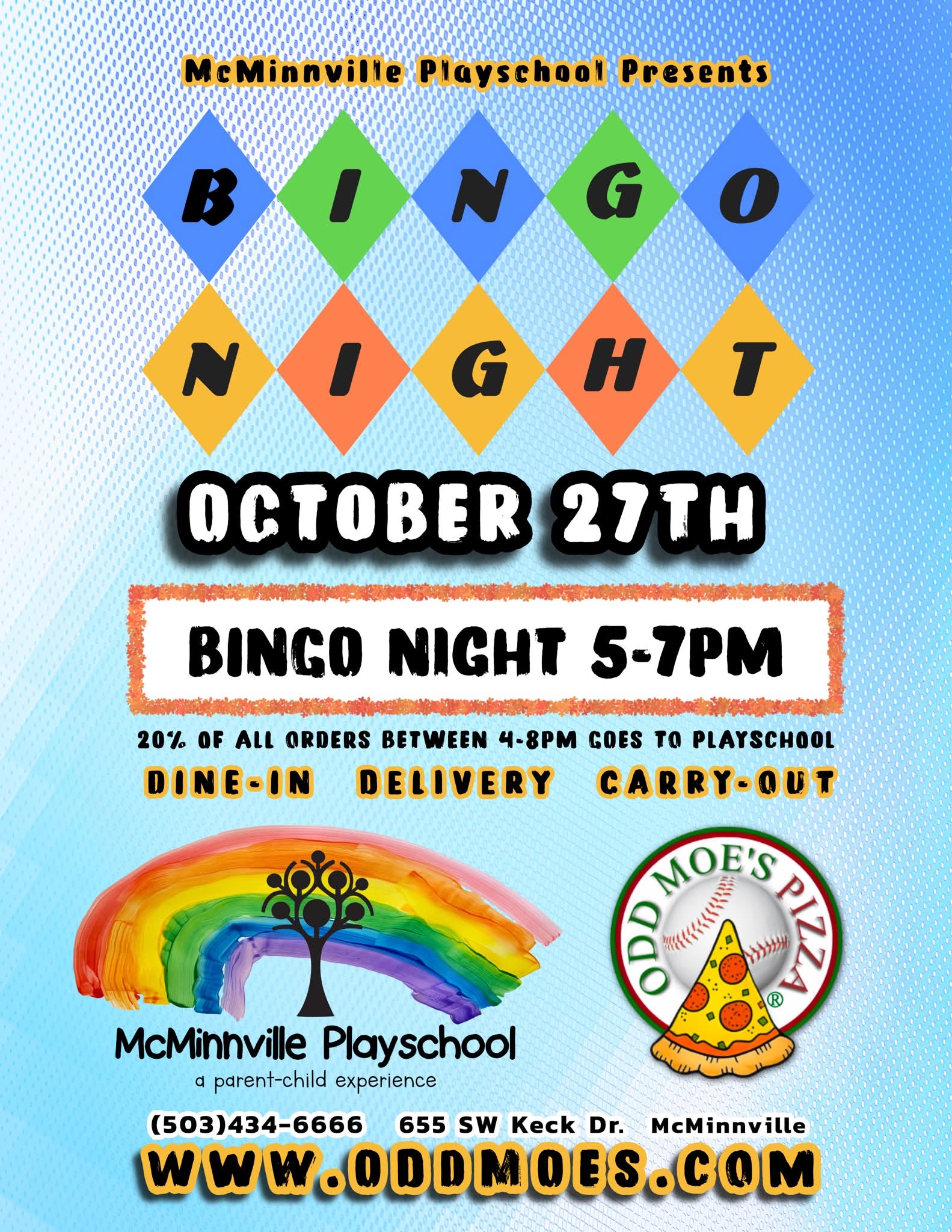
Even better, you can use your game-night skills in McMinnville, Oregon! On Sunday, October 27th, Odd Moe’s Pizza in McMinnville is having a special community Bingo Night fundraiser for McMinnville Playschool. From 4:00 PM to 8:00 PM, Odd Moe’s will donate 20% of proceeds from all orders (dine-in, delivery, and carryout) directly to McMinnville Playschool.
1. It All Started With Beans (The “Beano” Era)
Before players called out “Bingo,” they shouted the word: “BEANO!”
In 1929, Edwin S. Lowe, who was both a toy manufacturer and a salesman in the United States, went to a traveling carnival close to Atlanta in Georgia. He saw a large, enthusiastic crowd packed tightly around a carnival tent, all absorbed in a game of chance. The carnival vendor drew numbers from an old cigar box, while players used dried lima and pinto beans to cover stamped cardboard sheets.
As long as a contestant got a continuous horizontal, vertical, or diagonal line of beans, they would jump up and shout “Beano!” to win a cheap doll or trinket. Lowe watched, fascinated, as the contestants refused to get up from their seats for hours on end, asking the operator to keep the games going well into the night. Soon Lowe realized the potential of this simple, interesting game, took a few bean markers with him, and brought the idea back to New York City.
2. An Accidental Slip of the Tongue Named the Game
Back in New York, Lowe invited close friends over to try his homemade version of the carnival game, using numbered cardboard chits, cardboard cards, and dried beans from his pantry.
In a certain highly competitive and high-stakes round, a friend was just one bean away from winning. When Lowe pulled it out and declared the winning number. The player, overwhelmed by adrenaline, accidentally shouted:
“B-B-B-B-I-N-G-O!”
The shout went round the room. Lowe halted whatever he was doing and, for that moment, realised that their mistake had a much more powerful, more musical and more exciting sound than ‘Beano’. He at once saw the Bingo name as his trademark, arranged for factory production runs and presented the game to the national chain of department stores. That single accidental slip of the tongue had a permanent effect on the history of leisure and gaming in America.
3. A Columbia Math Professor Almost Went Crazy Making the Cards
Early in his commercial venture, Lowe faced a serious technical problem. Whenever more than twelve people played his standard game, several of the players always hit “Bingo” at the same time. The fact that numerous winners occurred at the same time caused confusion and reduced the competitive spirit.
Players wanted thousands of different cards, each with randomly arranged numbers, so that people could win individual rounds. In 1930, it would have been a huge computational task for a person to work out thousands of different mathematical combinations on a 5-by-5 grid.
To solve this logistical problem, Lowe hired Carl Leffler, a respected professor of mathematics at Columbia University. Lowe agreed to pay Leffler a fixed amount for each unique, non-repeating card combination he designed. When the professor reached card number 5,000, the task became immensely more difficult. The calculations became so mentally taxing that folklore says Leffler came close to a full nervous breakdown while doing the job.
Leffler ultimately came up with 6,000 different card combinations. Today, computer algorithms are able to produce millions of non-repeating matrices in just a few milliseconds. However, each printed card still quietly pays a tribute to the determined professor who used to work late into the night using a pencil and some scratch paper.
4. Winning in Four Calls Is Mathematically Possible (Just Don’t Bet the Farm)
If you’ve ever had to make thirty attempts to get through while seeing your opponent win all the prizes, you might then wonder what the fastest mathematical method is for achieving a win.
An ordinary American bingo card which has a pre-cleared central “Free Space” enables a player to achieve a regular straight-line bingo within just four calls.
While mathematically possible, the statistical probability is astronomical:
- There are more than 5.52 million different numeric combinations possible on a standard 75-ball card.
- The probability of winning with four calls is about 1 in 237,896.
To put that in perspective, you’re more likely to spot a four-leaf clover on your first look in the grass than to get a clean four-call bingo! It is precisely this unpredictability that makes the game so addictive, since each new ball that drops through the cage creates a new chance to win.
5. Bingo Has Deep Roots in Charity and Fundraising
The connection between the game and charitable fundraising goes back long before the advent of neon-lit bingo halls and modern charity lounges, and a Roman Catholic priest in Wilkes-Barre, Pennsylvania, has always been associated with it.
In the early 1930s, when the Great Depression was hitting the area, Father Edward McManus observed that his parish was suffering from severe financial deficits. Since he was looking for an activity which would be centered on the community and at the same time provide cheap entertainment, he got in touch with Edwin Lowe to purchase a number of sets of bingo cards. The parish then started weekly bingo nights in the basement of the church, taking a small entry fee and giving out modest prize packages.
The scheme succeeded in preventing the parish from being foreclosed upon and the news spread quickly throughout the various regional non-profit organizations, fire stations, community centers, and youth leagues. In just a few short years, thousands of grassroots groups began to use weekly bingo games to finance community services, buy civic equipment, and assist local schools.
Today’s charitable bingo schemes raise billions of dollars each year for a variety of grassroots civic projects, scholarships, and youth programs all over North America and are among the most effective of the current community-oriented fundraising activities.
6. The Superstitions Run Deep
In any competitive bingo room, you will find a variety of odd good-luck traditions. Enthusiastic players take their chances very seriously, building up personal superstitious beliefs that are just as strong as those of professional athletes:
- Players often decorate their tables with vintage troll dolls, small rubber ducks, four-leaf clover charms, and family photographs which face outward towards the caller.
- Attitude towards the dauber: Many players stick firmly to one particular color of ink dauber, claiming that switching from hot pink to neon green immediately brings bad luck.
- There’s a loyalty when it comes to seating: many regulars stick to sitting in the same chair at the same table, on the grounds that certain positions on the floor have their own special energy that brings about wins.
- The ‘Clear the Board’ Shake involves the players tapping their cards, blowing on them or rubbing them when a round has started badly in order to get rid of the negative atmosphere before the next round begins.
It makes a difference whether you take a pocket charm or simply have a positive attitude, since embracing these odd traditions contributes to the fun that everyone shares in the room.
7. It Provides a Proven Workout for Your Brain
Bingo is not only a fun way to spend an evening, but it also provides genuine cognitive health benefits for people of all ages.
Cognitive psychologists and neuroscientists have studied the game’s mental aspects. The processes involved in scanning complex matrix cards, interpreting the numerical cues that are heard, coordinating quick physical strikes with the dauber, and keeping a close watch on multiple boards at the same time call into play a number of important mental functions:
- Visual Processing: Rapidly scanning rows and columns develops quick spatial recognition.
- Retaining numbers in your working memory while comparing several cards improves concentration.
- Coordinating hand and eye movements by using your ears, eyes, and hands while under time pressure helps to activate neural pathways.
- Laughing and celebrating with friends can lower cortisol levels and improve emotional well-being.
A study by the University of Southampton found that people who played bingo regularly achieved higher scores in speed, accuracy, and mental agility than those who didn’t, across several age groups. To sum up, focusing on your card does actually constitute a workout for the brain!
Mark Your Calendar: McMinnville Bingo Night Fundraiser on October 27th
Now that you’ve learned the odd history, wild superstitions, and surprising facts about America’s most popular pastime, go to town and bring your good luck to a fantastic local cause!
Odd Moe’s Pizza in McMinnville is happy to be working with the community to support early childhood education. Every dollar raised will help local teachers, provide classroom supplies, and fund supportive programs for young children right here in Yamhill County.
3 Ways You Can Participate and Support the School
- Why not dine in and play? Bring your family, get your colleagues together, and choose a table at the McMinnville store. Take your cards, order a hot pie, and enjoy the game-night atmosphere face to face!
- You can place an order for takeout: come in and pick up a hot meal to go. In-store pickup orders also come with a free 2-liter soda!
- Fresh Delivery Direct to Your Door: Unable to visit the restaurant yourself? That’s no issue at all! Just turn on your phone or computer, place your order online, and have the pies made fresh for you at home. If you order between 4:00 PM and 8:00 PM on October 27th, then 20% of the proceeds will be donated to the children.
Pack your lucky charms, bring your loudest cheering voice, and join us on Sunday, October 27th, for a remarkable night of food, fun, and community giving!
Ready to check out the menu or plan your order in advance? Visit Odd Moe’s Pizza online or call the McMinnville store at (503) 434-6666 today!

Recent Comments